Why Green Roofs Are Making Solar Panels More Efficient in Australia
- Klaus Pichler
- 2 days ago
- 5 min read
Rooftop solar has become the default choice for commercial and residential buildings across Australia, and for good reason. But as more roofs fill up with panels, a new question is emerging: could the surface beneath the panels matter just as much as the panels themselves? A landmark Sydney study says yes — and the numbers are hard to ignore.
Researchers from the University of Technology Sydney (UTS), working with Lendlease, Junglefy and the City of Sydney, spent eight months directly comparing a standard rooftop solar array against a “Biosolar” roof — solar panels combined with a green roof — on two virtually identical buildings in Barangaroo. The result: the Biosolar roof produced 3.63% more energy, under matched light conditions, than the conventional PV-only roof next door. For property owners weighing up how to squeeze more value out of every square metre of rooftop, that's a number worth paying attention to.
Test Set-up
What makes this study stand out isn't just the result — it's the rigor behind it. Most previous green roof and solar research has compared buildings in different locations, of different ages, or with different construction, which makes it almost impossible to isolate cause and effect. This one didn't have that problem.
The researchers used two neighbouring, near-identical buildings in Barangaroo, Sydney:
1. Daramu House — a Biosolar roof combining photovoltaic panels with an extensive green roof
2. International House — a conventional roof with photovoltaic panels only, and no vegetation
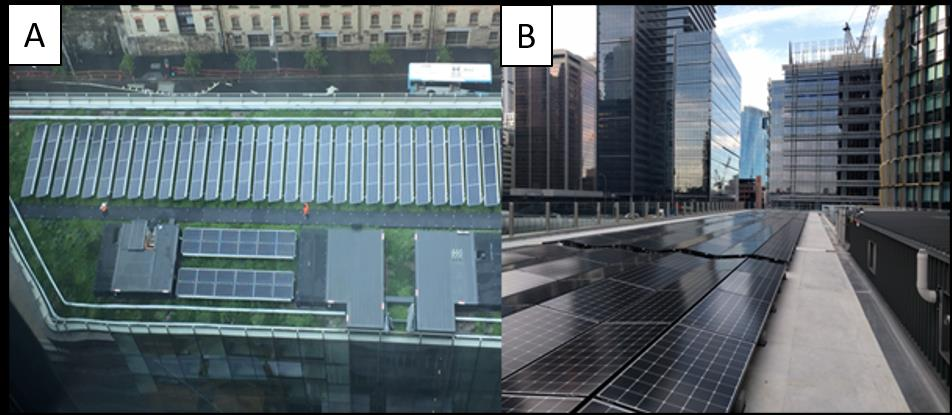
Both roofs are the same size (1,863 m²), similarly aged, and exposed to the same sun, wind and shading from surrounding towers. From September 2020 to April 2021, the team tracked solar output, panel and ground temperatures, and weather conditions using SolarEdge inverter data, weather stations, i-Button temperature loggers and thermal imaging cameras — 234 days of continuous, side-by-side data.
Crucially, the team didn't just compare raw output. They corrected the results for differences in panel efficiency, system capacity and panel age between the two roofs, then modelled both systems under identical simulated lighting conditions using 3D solar modelling software. That extra step is what turns an interesting anecdote into genuinely reliable evidence.

Findings
A measurable energy boost, even after the numbers were corrected
The headline figures speak for themselves:
• +13.1% more daily energy output on the Biosolar roof, in the raw, uncorrected data
• +6% higher output specifically around solar noon, when shading from surrounding buildings has the least influence
• +3.63% verified uplift once the results were standardised for panel type, system size, age and light conditions — the fairest comparison in the study
• Over the 8-month trial, that translated into 9.5 MWh more electricity, worth roughly $2,595 in extra retail revenue, and 7.7 additional tonnes of CO2e avoided — about the same as planting 110 trees

The secret ingredient: a cooler roof
Why would greenery make a solar panel produce more electricity? The answer lies in temperature. Solar panels lose efficiency as they heat up, and the study's thermal sensors showed the green roof was consistently cooler underneath the panels than the bare conventional roof — in some conditions, ground-level temperatures were up to 30.5°C lower. That cooling effect, driven by plant evapotranspiration and shading, appears to give the panels above a genuine performance advantage, especially through Australia's hot summers.
More than just electricity
While energy output is the headline for this post, it's worth noting the Biosolar roof delivered a stack of other benefits over the same period: nine times the insect biodiversity, four times the bird species richness, a modelled reduction in peak stormwater flow from 634 L/s to just 7 L/s in a 1-in-5-year storm, and measurable removal of NO2, ozone and particulate matter from the air. For any building chasing a Green Star rating or ESG targets, that's a compelling secondary case.
Implications for green roof projects in Australia
For property owners, developers and facility managers in Australia, this study reframes the rooftop as more than just space for panels — it's an opportunity to combine functions. A few practical takeaways:
• Rooftop real estate can do double duty. Instead of choosing between a green roof and a solar array, this research shows the two can work together, with the vegetation actively supporting panel performance rather than competing with it.
• Cooling matters as much as tilt or orientation. The same physics that make a green roof boost panel output — keeping modules cooler — is part of why alternative array designs, including vertical solar layouts, are also gaining attention as ways to manage heat and light exposure more intelligently.
• The business case stacks up over time. A 3.63% output gain might sound modest on a single panel, but scaled across a commercial rooftop array over its lifetime, it adds up to a meaningful difference in generation, revenue and emissions avoided — on top of the stormwater, biodiversity and air quality benefits that increasingly matter for building certifications.
• Design integration should start early. The panel layout, tilt and spacing on the Biosolar roof in this study were adapted specifically to accommodate the greenery, suggesting the best results come from designing the two systems together, not retrofitting one onto the other as an afterthought.
It's worth being upfront about the limits of the study too: it ran for 8 months rather than a full year, so winter performance wasn't captured, and it's based on a single pair of buildings. The researchers themselves recommend further studies at scale before extrapolating these results too broadly — but as a proof of concept, it's a strong one.
Conclusion
The University of Technology Sydney's Barangaroo study offers some of the most rigorous, real-world evidence yet that a green roof in Australia isn't just a nice-to-have for biodiversity and aesthetics — it can genuinely improve the performance of the solar panels sitting above it. A verified 3.63% energy gain, driven by a cooler rooftop microclimate, adds up to real money, real emissions savings, and a stronger case for renewable energy investment across Australian cities.
As pressure grows on developers and building owners to do more with every square metre of roof space, this kind of integrated thinking — solar plus greenery, designed together from the start — looks less like a niche experiment and more like where commercial rooftop design in Australia is heading.
Source: Green Roof & Solar Array – Comparative Research Project
Final Report July 2021, University of Technology Sydney

